
How AI is reshaping lab furniture, workflows, and the way teams work
Artificial intelligence (AI) is no longer a side project in research and development (R&D)—it’s changing how experiments are planned, run, monitored, and documented. As AI-assisted and autonomous (“self-driving”) science becomes mainstream, lab furniture isn’t just background scenery; it’s the physical platform that makes smarter workflows possible. This article translates the AI wave into concrete design moves for wet labs and tech labs—so your benches, casework, and work zones evolve as fast as your science.
Why AI Forces a Rethink of Lab Layouts and Furniture
AI shifts the bottleneck from manual operations to data-rich, instrument-dense workflows. That creates very practical demands on the built environment:
- Modularity and speed of change: Benches and casework must reconfigure in hours, not weeks, as protocols and instruments iterate rapidly.
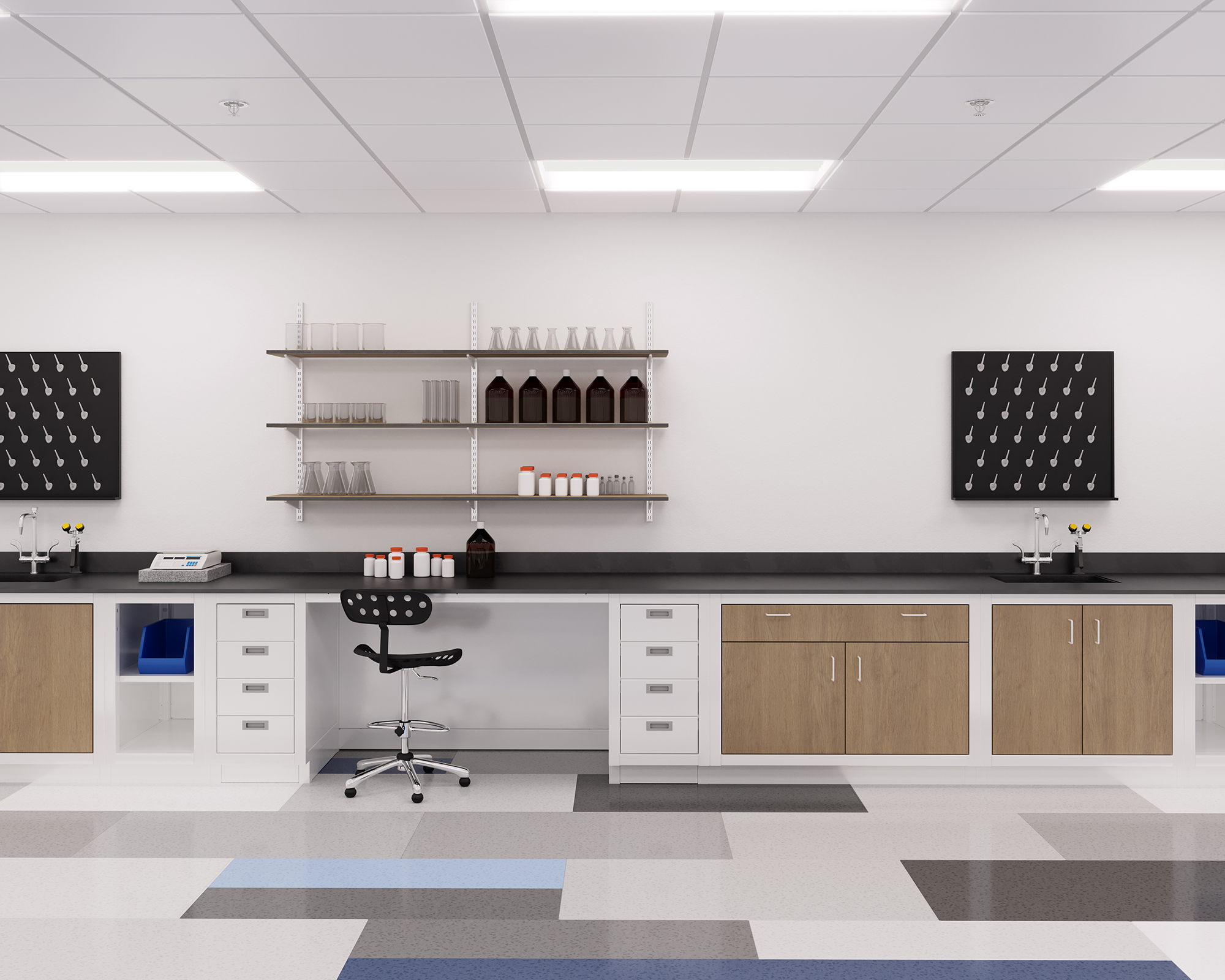
- Power and data density: More outlets per bay, clean cable management, segregated network ports, and uninterruptible power supply (UPS) for critical edge compute.
- Thermal and vibration control: Graphics processing units (GPU)/edge compute adds heat and fan noise; imaging and vision tools need anti-vibration feet options and controlled lighting.
- Robot/cobot readiness: Clear reach envelopes, rounded edges, flush-mounted fixtures, emergency stops within arm’s reach and dedicated guarded zones.
- Vision-friendly work surfaces: Non-glare, uniform matte surfaces and clutter-free sightlines for reliable computer-vision quality control (QC).
- Electrostatic discharge (ESD) and cleanliness: Mixed tech lab + wet lab footprints benefit from ESD-safe, easily cleanable tops; integrated barcode/ radio-frequency identification (RFID) cradles support traceability.
The big picture is, in AI-enabled labs, data becomes an instrument—and the furniture becomes the platform that powers, cools, connects, and safeguards it.
Want to go deeper? Start with self-driving lab primers (ACS Chemical Reviews; Nature Reviews), pair them with the Food and Drug Administration’s (FDA)Good Machine Learning Practice (GMLP) principles, and anchor your data strategy in Findable, Accessible, Interoperable, Reusable (FAIR) best practices.
Furniture & Layout Requirements for AI-enabled Labs (The Essentials)
Modularity & reconfigurability
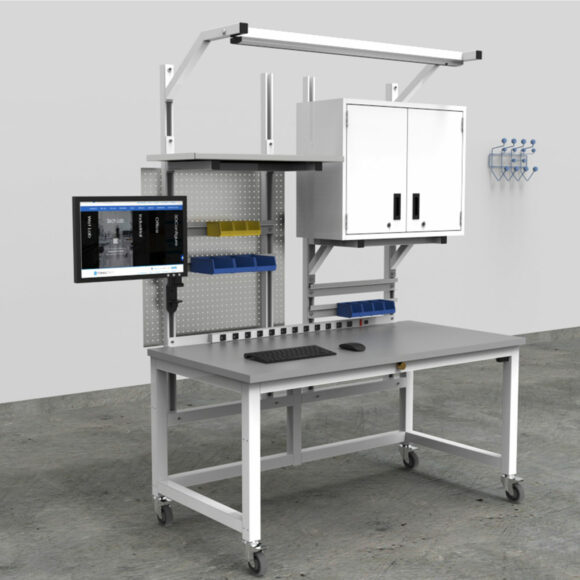
- Rail-based uprights and standardized hole patterns for fast re-mounting of cameras, sensors, dispensers, and small robots.
- Benches on locking casters with quick-connect utilities to shift from optimization to production runs without a construction project.
Power & data done right
- 120/208/230V planning per bay; surge protection; UPS for edge servers; Power over Ethernet (PoE) drops for sensors.
- Horizontal and vertical raceways to keep power/data separate and serviceable; rear grommets and under-bench trays to keep sightlines clean for vision systems.
Thermal, vibration, and acoustic control
- Anti-vibration tops, isolation pads, or anti-vibration feet under microscopes/inspection tables.
- Ventilated central processing unit (CPU)/GPU enclosures with service clearance; avoid baking your inference hardware.
Robot/cobot integration
- Rounded bench corners and flush hardware to prevent gripper snags.
- Clearly marked collaboration zones and light curtains or safety scanners where appropriate.
- Mounting plates and T-slots for quick fixturing and repeatability.
Security & compliance at the bench
- Lockable CPU/edge boxes; tamper-evident storage for critical reagents/samples.
- Labeling surfaces and barcode shelves to keep audit trails tight.
Wet Lab: AI Applications You Should Plan Furniture Around
- Self-driving experiments & materials discovery: Robotic liquid handling guided by ML planners. Furniture needs: robot-friendly cutouts, enclosed safety shields, spill-management and waste routing, and standardized mounts.
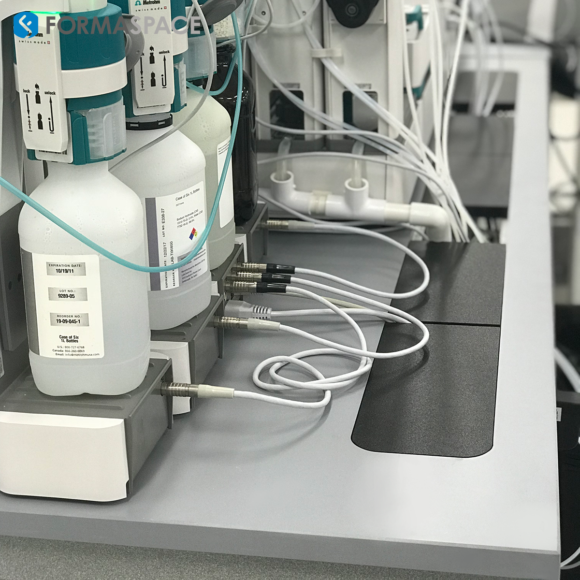
- Computer-vision QC: Plate/gels/colony imaging at the bench. Furniture needs: matte, neutral backboards; fixed camera rails; cable-free sightlines; anti-glare task lighting.
- Assay optimization via Machine Learning (ML)/Design of Experiments (DoE): Frequent instrument swap-outs. Furniture needs: quick-connect utilities, standardized bench depths, adjustable shelving for changing deck heights.
- Inventory & sample tracking (RFID/vision): Furniture needs: integrated scanner cradles, label printer shelves, staging trays sized for common carriers.
- Predictive maintenance: Furniture needs: sensor mount points, access panels, and service-clearance envelopes documented right on the bench.
- FAIR-by-design data capture: Furniture needs: Electronic lab notebook (ELN)/ Laboratory information management systems (LIMS) touchpoints—swing-arm monitors or tablet mounts at the bench; barcode flags and durable label pads.
Tech Lab: AI Applications & the Furniture Implications
- AI-assisted test & measurement (drift detection, anomaly flagging): Furniture needs: anti-vibration tops, electromagnetic interference (EMI)aware cable separation, shielded raceways.
- Edge inference for inspection (microscopy, electronics, optics): Furniture needs: ventilated GPU/edge compute bays; acoustic baffles; easy access for swaps.
- Autonomous device test loops with cobots: Furniture needs: guarded bench zones, emergency-stop reachability, standardized fixturing points.
- Interoperable automation (Standardization in Lab Automation (SiLA)/ELN/LIMS): Furniture needs: dedicated IT shelves, clean panel-mount ports, cable raceways that keep data lines serviceable.

Tip: specify uniform bench heights and standardized hole patterns across bays. AI tools thrive on repeatability; your furniture should too.
People & Process: How Lab Teams Should Embrace AI
- Upskill for the data layer: Basic ML literacy for scientists/techs; versioning for models and protocols; barcoding every step to create usable training data.
- Human-in-the-loop by design: Decide what gets automated and what requires sign-off; place physical stop buttons and status displays on the furniture, not hidden behind equipment.
- Make FAIR routine: Treat metadata capture as part of the standard operating procedures (SOP)—ELN prompts at the bench, standard field sets for samples, and barcode standards visible at each station.
- Change management: Pilot one workflow on a single AI-augmented bench, measure throughput/defect deltas, then scale across identical modular cells.
Safety, Compliance, and Cybersecurity (Don’t Skip This)
- Robot collaboration safety: Align with established collaborative-robot safety frameworks; use signage, floor markings, and guarded zones that are literally built into the bench layout.
- Regulated workflows: If your AI supports diagnostics or regulated outputs, align procedures with current best-practice guidance (data lineage, validation, monitoring) and maintain audit trails at the bench.
- IoT hygiene at the edge: Isolated virtual local area networks (VLANs) for instruments, lockable compute enclosures, and physical cable security. Keep power and data separated in raceways to cut noise and tampering risk.
“NextGen Labs” by Formaspace: On-Carpet vs. Off-Carpet
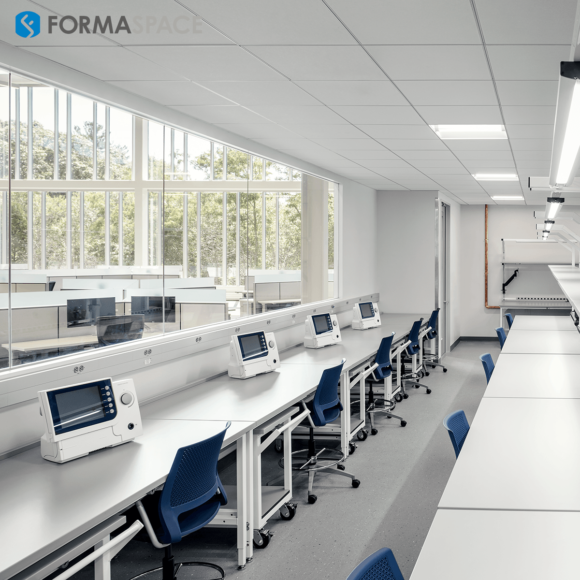
We adopt NextGen Labs concept: the on-carpet zone (analysis, admin tasks, collaboration, visualization) and the off-carpet zone (wet and tech lab production). AI workflows thrive when these spaces are planned together. That means:
- On-carpet: visualization walls, ELN/LIMS workbars, quiet GPU/edge racks with proper cooling.
- Off-carpet: robot-ready benches, clean utilities, safety-first layouts, and high power/data density.
Treat the handoff between zones as a design feature—shared standards for labeling, trays, carts, and data capture make the whole system faster and safer.
A Phased Roadmap (Your Checklist)
- Readiness: Audit power/data density, add sensor/camera rails, standardize label formats, adopt FAIR templates in ELN.
- Pilot cell: One AI-augmented bench with vision + cobot; track key performance indicators (KPIs) (throughput, changeover time, defects, uptime).
- Scale-out: Duplicate the cell with a kit-of-parts; maintain identical bench specs for repeatability.
- Optimize: Add predictive maintenance sensors, build work-cell digital twins, refresh SOPs quarterly.
Why Work with Formaspace
We build modular, robot-ready, AI-friendly furniture designed for the realities of autonomous science—anti-vibration benches, ESD-safe options, integrated power/data raceways, and cobot-compatible edges and fixtures.
Whether you’re piloting a single AI workflow or scaling an enterprise-level autonomous lab, Formaspace can turn complex requirements into a flexible kit of parts that evolves with your science.
Let’s design your AI-ready NextGen Lab—connect with your local representative today to start building the future.