NextGen Labs: Designing the Handoff Between On-Carpet and Off-Carpet (and what we’re bringing to Healthcare Design Conference 2025)
If you’ve sat in a lab planning meeting lately, you’ve felt it: science moves faster than most buildings. That’s the core of NextGen Labs—a design approach that treats lab spaces as a connected ecosystem instead of disconnected silos. In practice, that means designing the on-carpet zone—dedicated to offices, meeting areas, and data-driven work—together with the off-carpet zone—dedicated to wet and technical lab activities—so people, information, and materials move seamlessly between the two.
What NextGen Labs actually solves
At its simplest, NextGen Labs makes four things easier for organizations:
- Efficiency: less wasted movement and faster communication
- Visibility: science made central and credible (not hidden in back rooms)
- Talent: inspiring environments that attract and retain top researchers
- Culture: scientists, engineers, and business teams working side-by-side
- Branding: making the space itself reflect your mission and identity
Those aren’t slogans; they’re design outcomes we plan for explicitly.
Design principles you can see at the bench
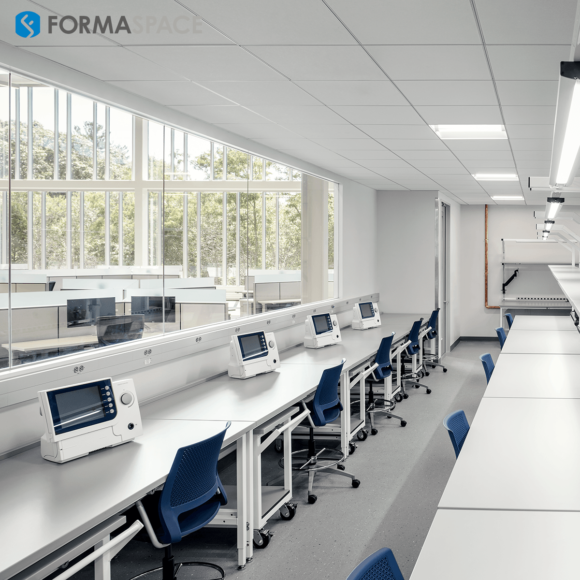
A NextGen plan shows up in tangible choices: more natural light and biophilia, demountable glass to maintain sightlines, ergonomics dialed in for long work sessions, adaptability to change layouts quickly, and proximity between analysis and production so collaboration isn’t a calendar event—it’s the default.
It also shows up in the furniture: standardized heights and hole patterns, clean cable raceways, integrated utilities, and robot-ready surfaces for tech labs. We favor layouts that make adding or moving instruments as simple as adjusting shelves—not requiring construction.
Where the industry is headed (and how furniture keeps up)
Looking forward, three trends are accelerating the shift: modularity, wellness, and technology. For us, that translates into workbench systems and adaptable casework that reconfigure without drama (our FLX benches and RGX modular casework pivot as projects evolve), wellness features that make long hours more sustainable, and AI/IoT-ready layouts that support sensors, vision, and edge compute at the bench.
The payoff is operational: faster changeovers, fewer handoffs, and consistent specs across programs and sites. When the on-carpet/off-carpet handoff is designed—not improvised—teams move faster with fewer mistakes.
One Manufacturer for All Spaces (why standardization matters)
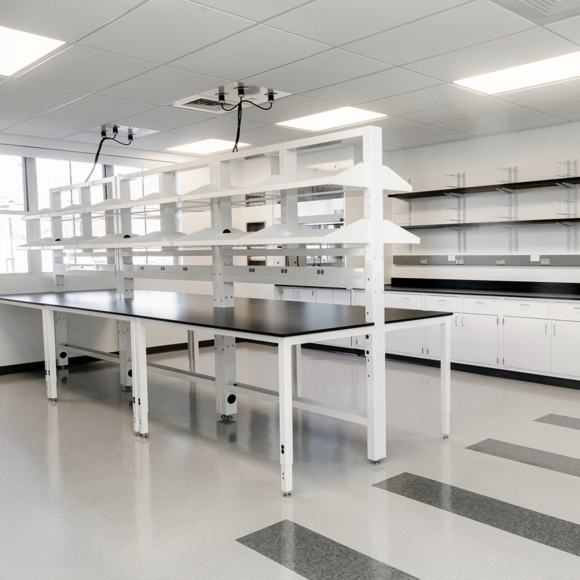
If NextGen Labs is the what, One Manufacturer for All Spaces is the how. Standardizing benches, casework, and integrated utilities across different rooms—wet labs, tech labs, write-up zones, collaboration areas—cuts friction in design, submittals, procurement, and install. It also makes future moves/adds/changes predictable. In enterprise rollouts, that consistency is the difference between “we think this will fit” and “we know it will fit.”
We approach standardization as an ecosystem, not a single SKU: compatible uprights and rails, consistent worksurface families (including chemical-resistant and ESD-safe options), repeatable power/data layouts, and storage that scales from one bay to a floorplate. When every space pulls from the same playbook, maintenance is simpler, replacement is faster, and training gets easier.
What we’re showing at HCD (and why)
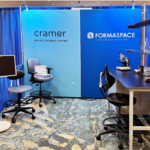
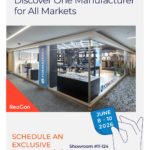
At HCD 2025—Kansas City Convention Center, Booth 805, October 25–28—we’re bringing concept installations designed to spark practical conversations in limited space. You’ll see how the NextGen approach looks in two verticals: Life Sciences & Healthcare and Pharmaceuticals.

To make the breadth of applications obvious, we’re also presenting a miniature pharmaceutical company model. In a quick walkthrough, you can visualize how one manufacturer supports many different zones—lounge/cafeteria, conference, collaboration, R&D lab, cleanroom, open office, and distribution—without juggling mismatched specs.
On the floor, look for:
- RGX adaptable casework for reconfigurable storage, utilities, and standardized components (built for fast changes and enterprise standards)
- FLX back-to-back services bench for integrated utilities and team workflows
- Custom compounding lab bench purpose-built for pharmaceutical accuracy and cleanability
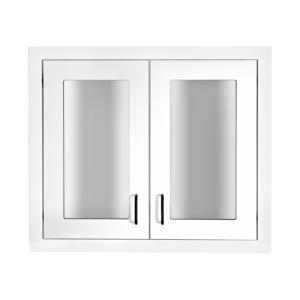
- Lab cabinet staged on the pharma side (developed with our partner AMS – Air Master Systems)
These are conversation starters—compact “proof points” for how standardization and adaptability show up in real projects.
Give credit where it’s due
The booth’s concept and flow come from our lead designer, Brett Gray, who translated the on-carpet/off-carpet playbook into a tight show footprint without losing the storyline. On the go-to-market side, Katharina Weisflog, our Marketing Operations Manager, has been the force behind the scenes—wrangling assets, schedules, partners, and a dozen moving parts so the story lands cleanly at HCD. And yes, the broader team—design, engineering, operations, and marketing—has been sprinting to pull this together; special thanks to Mehmet Atesoglu for aligning the resources and connecting all the dots.
Why meet at the booth
If you’re planning a build or a multi-site rollout, the fastest way to see where NextGen Labs can save time and reduce risk is to walk the model, touch the furniture, and talk through your constraints with our team. Bring your floorplate, and let’s map the handoffs—what belongs on-carpet, what belongs off-carpet, and how to standardize the parts in between.

See you at HCD 2025—Booth 805, October 25–28, Kansas City. If you want to lock a time, you can schedule a meeting with our team from the event page. https://formaspace.com/resources/inspiration/events/hcd-2025/